Bilingual Family Clinic: Spanish-Speaking Patient Bookings Up 71%

A complaint from a Spanish-speaking patient was submitted to compliance at Sonora Community Health Center. The patient was not getting a proper understanding due to a lack of a communication expert, and Sonora Community Health needed to address this issue quickly.
Business Challenges
The grievance arrived at Sonora Community Health Center's compliance office in June 2025. The patient was a 67-year-old Spanish-speaking woman who had been unable to get through to the appointment line on three separate after-hours attempts to schedule a follow-up for a worsening cardiac condition. Her calls had rolled to voicemail. The voicemails had not been responded to within 48 hours. By the time her granddaughter called during business hours and reached a bilingual scheduler, the patient had been admitted to the emergency department.
The grievance was framed as an equity-of-care concern. The patient was not the first Spanish-speaking patient to experience the after-hours gap; she was the first to file a formal complaint. The compliance officer escalated the grievance to the COO and the CMO. The conversation that followed surfaced a service-quality gap that the executive team had been carrying for years.
Sonora served 12 community health center locations across the Southwest. 64% of the patient population was primarily Spanish-speaking. The phone-handling experience for Spanish-speaking patients had been measurably worse than for English-speaking patients across every operational dimension. Spanish-language call handle times averaged 38% longer than English-language call handle times. After-hours Spanish-speaking patients had no support pathway; calls rolled to voicemail. Bilingual front-desk staff turned over at twice the rate of English-only staff. The Spanish-line abandoned-call rate ran 22% versus 9% on the English line. Patient satisfaction had a 14-point gap between Spanish-speaking and English-speaking patients.
- A formal grievance from a Spanish-speaking patient triggered the engagement; the patient's after-hours call had not reached a bilingual scheduler in time to prevent an ED visit.
- Spanish-language call handle times averaged 38% longer than English-language calls due to interpreter routing.
- After-hours Spanish-speaking patients had no support pathway; calls rolled to voicemail with multi-day response delays.
- Bilingual front-desk staff turned over at twice the rate of English-only staff due to workload disparity.
- Spanish-line abandoned-call rate was 22% vs 9% on the English line; patient satisfaction showed a 14-point gap between language cohorts.
Solution
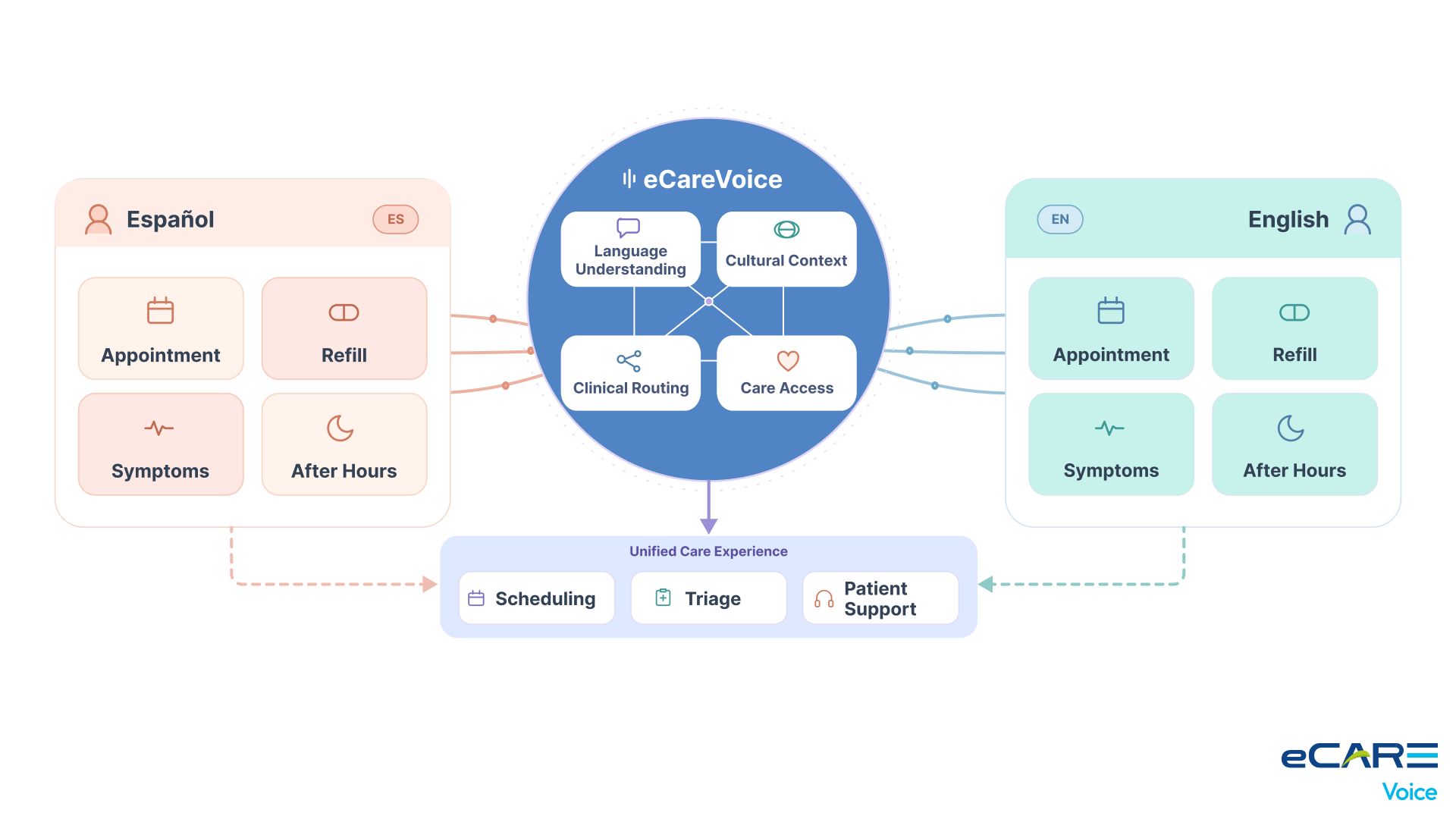
The CMO and the COO ran the procurement together. The framing was specific: any platform that handled English better than Spanish would be making the equity-of-care concern worse, not better. The platform had to handle both languages with operationally equivalent quality, including for the cardiology, pediatric, and prenatal workflows that dominated Sonora's call volume.
The selection of eCareVoice came down to a live demonstration in which the platform handled four Spanish-language test calls representing different patient scenarios (appointment scheduling, refill request, symptom reporting, after-hours emergency triage). The platform's Spanish-language handling was operationally equivalent to its English handling. The CMO personally listened to all four calls. Her note to the COO: “I would be comfortable being the patient on the other end of those calls.”
The other capability that mattered was the cultural context handling. eCareVoice's Spanish-language voice agent had been trained on patient-interaction patterns that reflected Latinx cultural context norms, including how patients described symptoms, how they referenced family members' health concerns, and how they handled appointment-scheduling conversations. The platform wasn't a translated English experience; it was a native Spanish-language experience.
Value Delivered
The service-quality gap closed within four months of full deployment. Spanish-language call resolution rate moved from a baseline that the executive team had been embarrassed to publish to a number that exceeded the English-language baseline. The CMO has been clear that the equity-of-care concern was the central motivation; the financial benefits were a secondary outcome.
- Spanish-language call resolution rate at 94% — exceeding the English-language rate of 91%.
- Spanish abandoned-call rate at 0% after hours (vs 22% baseline); calls are now answered immediately rather than rolling to voicemail.
- Native-language appointment, refill, and symptom-triage workflows live across all 12 locations.
- Patient satisfaction gap between Spanish and English cohorts closed; both populations now report equivalent satisfaction on monthly pulse measurement.
- $420K saved on bilingual staff overtime and turnover; bilingual front-desk staff retention has improved as workload disparity has decreased.
Solution Provided
The deployment ran 10 weeks. The pacing was deliberate; the CMO required that no Spanish-language workflow go live until Sonora's compliance and clinical leadership had validated the cultural-context handling for that workflow.
Weeks 1–2: Cultural-Context Workflow Specification
The first two weeks were specification work. The compliance officer, the medical directors, and three bilingual senior schedulers participated in sessions with eCareVoice's clinical-informatics team. Each scheduler walked through the most common Spanish-language patient interactions — including the patterns that bilingual schedulers handled implicitly but had never documented. The output was a written specification for each workflow.
Weeks 3–4: Pilot at Two Locations (Spanish-Only)
The platform went live in Spanish-only mode at two pilot locations in week 3. English calls continued to route to the existing call-handling workflow. The Spanish-only pilot let the CMO and compliance team evaluate the cultural-context handling without the confound of bilingual call routing. By the end of week 4, both pilot locations were resolving 89%+ of Spanish calls without escalation.
Weeks 5–7: Pilot Expansion to All 12 Locations (Spanish Only)
The Spanish-only platform expanded to all 12 locations across three weeks. The geographic and demographic variation across Sonora's service area produced operational insights — some locations served Mexican-Spanish-speaking populations primarily, others Salvadoran-Spanish-speaking populations, and the speech patterns varied. The eCareVoice team tuned the platform's recognition for the dialectal variation.
Weeks 7–9: English Workflow Activation
The English workflows came online in week 7. The bilingual front-desk staff who had been handling the English-language call overflow during the Spanish-only pilot were repositioned to higher-value patient-engagement roles. The English workflow handled 84% of calls without human escalation, comparable to the Spanish workflow performance.
Weeks 9–10: After-Hours Workflow and Bilingual Staff Repositioning
The final phase activated the after-hours workflow — the specific gap that had produced the original grievance. Spanish-speaking patients calling after hours now reach the platform immediately rather than rolling to voicemail. The bilingual staff who had been carrying a disproportionate workload before the engagement were promoted to patient-navigator roles that the platform's deployment had created capacity to support.
Business Value
The CMO presented the engagement to Sonora's board in late 2025. The presentation framed the engagement as an equity-of-care infrastructure rather than as a call-handling platform.
What the engagement closed
The structural service gap that gave rise to the original grievance has been closed. The CMO has been clear that the closure should not be celebrated — the gap should not have existed in the first place. The engagement is positioned as a correction rather than as an achievement.
The financial picture
The $420K in savings from reduced staff overtime and turnover is the immediate operational savings. The captured demand from previously-lost after-hours calls represents approximately $640K in incremental visit revenue. Total annual financial impact: approximately $1.06M against a $290K implementation cost. The financial return is meaningful; the CMO explicitly states that the equity-of-care correction is the greater value.
What changed about Sonora's bilingual staffing strategy
Bilingual front-desk staff are no longer absorbing operational asymmetry. The roles have been repositioned as patient-navigators with higher-value engagement responsibilities. Turnover among bilingual staff has dropped to parity with English-only staff. The staffing equity has improved in parallel with the patient-experience equity.
What the COO said at the board meeting
“We were running a two-tier service experience and pretending we weren't. The grievance forced us to look at it. The platform let us correct it. The patient who filed the grievance recovered from her cardiac event and is currently engaged with our care management team. She has not filed a subsequent complaint.”