Multispecialty Group Replaces Front-Desk Overflow with AI Voice

The front-desk lead at the Highline Medical Group retired, and it was getting difficult to find the right replacement. The COO couldn't hire her replacement at any reasonable wage. The operational alternative was to rethink how front-desk work happened.
Business Challenges
The leadership at the Highline Medical Group had been preparing for the transition for a year, expecting to hire a successor from within the front-desk team and backfill the entry-level role from the local labor market. The local labor market was empty. Maxine ran an open requisition for a front-desk position for six months and produced four qualified candidates, all of whom accepted higher offers elsewhere within two weeks of the interview.
The operational reality at Highline was that the front-desk function had been increasingly difficult to staff for three years. Wage inflation in the entry-level service economy had compressed the margin that Highline could pay against competing employment options. The three remaining front-desk staff were maxed out absorbing the volume Janice had been carrying. Average call wait time had climbed to 6:42. Abandoned-call rate sat at 14%. Appointment scheduling errors had produced 38 double-bookings per month. Refill requests took a 2-day average turnaround.
Maxine raised the issue with the partner board. The partner group's response was unusually direct: the front-desk function as Highline had structured it for thirty years was not viable in the current labor market. Either Highline would restructure the function, or it would continue absorbing increasing operational deterioration. The decision was to restructure.
- Front-desk lead retirement triggered an unfilled hiring gap; the local labor market did not produce qualified replacement candidates at sustainable wages.
- Inbound call volume averaged 320 calls per day across three remaining front-desk staff; the team was operationally overwhelmed.
- Average call wait time climbed to 6:42; abandoned-call rate sat at 14%.
- Appointment scheduling errors produced 38 double-bookings per month; refill requests took a 2-day average turnaround.
- Front-desk operating cost was $310K and growing; the cost trajectory had no clear path to scale without a structural change.
Solution
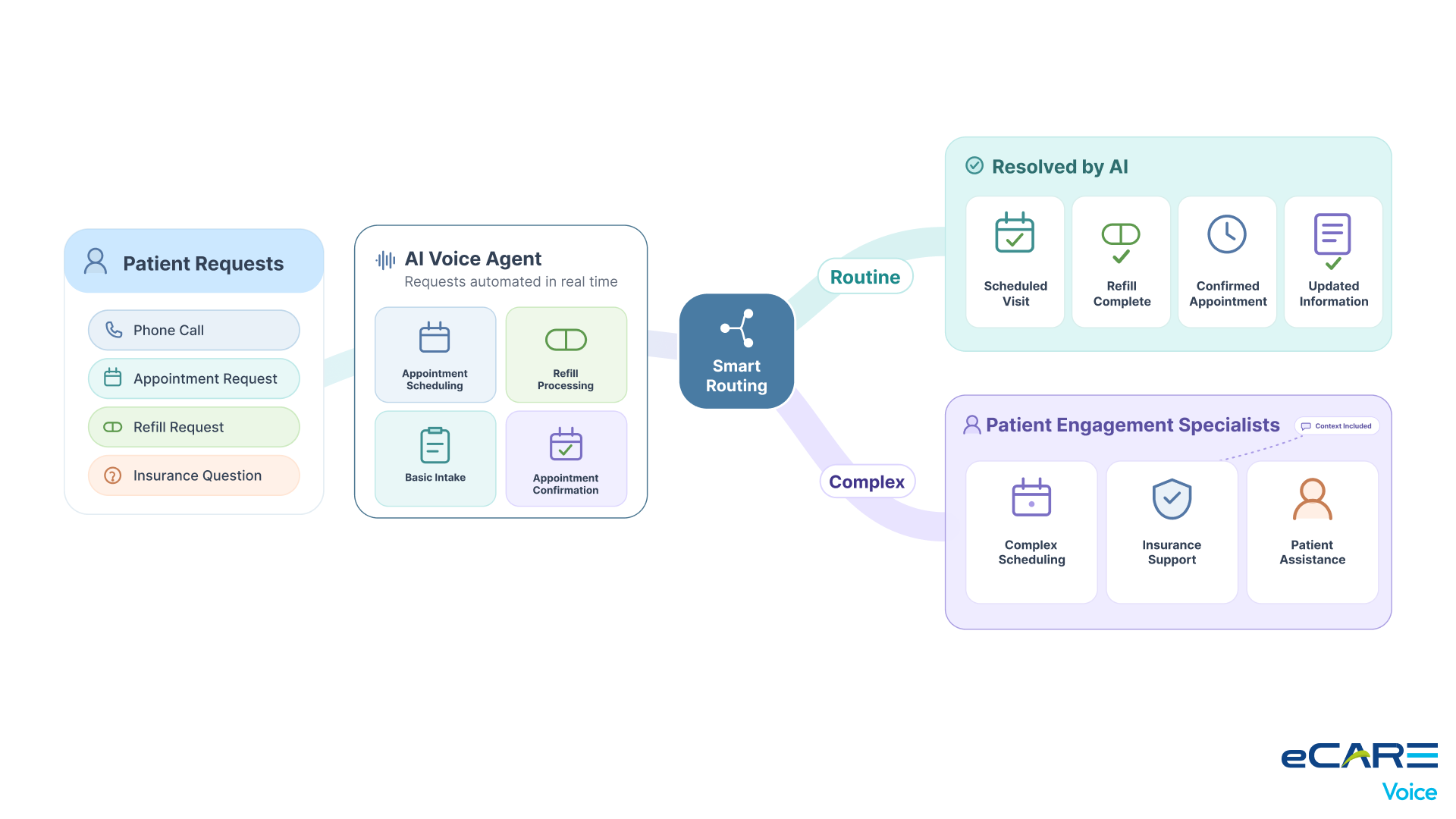
Maxine's procurement was framed around an operational philosophy that the partner board had endorsed: the work that didn't require human judgment should be removed from the front-desk team, and the human team that remained should focus on the work that genuinely required judgment. The platform had to absorb the routine work — appointment scheduling, refill requests, basic intake — while routing the judgment work to human staff.
eCareVoice was selected after a multi-week evaluation in which Maxine and her three remaining front-desk staff participated in voice-agent test interactions. The staff's verdict was important — they would be working alongside the platform and would be the immediate beneficiaries of its capability or the immediate sufferers of its limitations. The platform's voice quality and conversation handling met their threshold. The staff's lead, Diane Marker, told Maxine, “If this handles the boring calls, I'd get to do the calls that actually need a person.”
The other capability that mattered was the operational handoff design. eCareVoice's platform handled the routine calls and routed the exceptional calls to the remaining human staff with full context. The human staff wasn't picking up calls cold; they were receiving calls with the conversation history and the routing reason. The handoff was operationally clean.
Value Delivered
The volume absorption happened immediately. Within the first 30 days, the platform was handling 78% of inbound calls without human escalation. Wait times for the human-handled calls dropped to zero because the human staff had the bandwidth to pick up immediately. The front-desk operating cost dropped, the operational quality improved, and the structural staffing problem was no longer existential.
- 84% of inbound calls resolved by voice agent without human handoff.
- Average wait time dropped from 6:42 to 0:00 — immediate pickup on all calls (voice agent or human).
- Patient satisfaction with voice-agent interactions: 96%.
- Front-desk operating cost dropped $190K annually; the structural cost trajectory inverted.
- Double-bookings dropped to zero post-deployment; appointment-scheduling errors were eliminated through platform-handled scheduling.
Solution Provided
The deployment ran 8 weeks. The work was scoped tightly because the operational pressure was acute and the partner board wanted visible relief within the quarter.
Weeks 1–2: Workflow Configuration with the Remaining Front-Desk Staff
The first two weeks were workflow configuration with Diane and her two colleagues. The staff documented the routine calls they had been handling — appointment scheduling, confirmation, refill requests, results inquiries, basic intake — and the eCareVoice team configured the platform's workflows against the documented patterns. The staff also defined the escalation triggers — the conversation patterns that required human handoff.
Weeks 3–4: Pilot Mode at the Practice's Smallest Location
The platform was piloted at Highline's smallest location for two weeks. Routine calls are routed to the voice agent; exceptional calls are routed to the front-desk staff. The staff monitored the voice agent's handling in real time during the first week; by the second week, they were monitoring on exception only.
Weeks 4–6: Full Practice Deployment
The platform was deployed across the remaining practice locations in two waves. By week 6, the platform was handling the practice's full inbound call volume. The remaining front-desk staff had visible bandwidth for the first time in years. Diane spent three days reorganizing the front-desk physical space to support the new operational pattern.
Weeks 6–8: Handoff Workflow Tuning
The final phase tuned the human-handoff workflow. Some call patterns that initially triggered handoff were configured to be voice-agent-handled after the staff observed the patterns. Other patterns that initially routed to the voice agent were elevated to human handling. The tuning continued for two weeks; by week 8, the routing was stable.
Business Value
Maxine presented the engagement to the partner board in mid-2025. The framing was that Highline had structurally repositioned a function that the labor market had rendered untenable.
What changed about Highline's operating model
The front-desk function as Highline had structured it for thirty years no longer exists. The new structure has three remaining staff in elevated roles (Patient Engagement Specialists, with higher compensation than the prior front-desk role) plus the voice-agent platform handling routine volume. Highline is no longer hiring against a labor market that wasn't producing candidates. The operational stress that had been compounding for three years has been resolved.
The financial picture
The $190K annual front-desk cost reduction is the direct financial impact. The avoided cost of additional hiring (which Maxine estimates would have required $240K annually to address the volume) is deferred indefinitely. Patient retention improvements driven by reduced wait time and elimination of scheduling errors represent approximately $480K in retained annual revenue. Total annual financial impact: approximately $910K against a $180K implementation cost.
What changed about the three remaining staff's work
Diane and her two colleagues now do work they describe as genuinely engaging. They are handling complex patient situations, complex scheduling problems, and complex insurance questions — work that requires human judgment. The compensation reflects the elevated role. Their job satisfaction, measured on quarterly pulse, has improved meaningfully.
The COO's framing
“We were trying to hire for a job that the labor market wasn't producing. Instead of accepting deteriorating operations, we restructured the work. The platform absorbed the routine. Our remaining staff got more interesting jobs at higher pay. The patients got better service. The labor-market problem hasn't disappeared, but it stopped being our problem.”