Urgent Care Network Books 2,400 Same-Day Visits via AI Voice After-Hours
The Midwest needed to fix its scheduling for urgent care to overcome a new 24/7 available competitor next door. This is where AI voice solved their after-hours booking challenge seamlessly.
Business Challenges
A national urgent-care chain announced and launched a 24/7 online and phone-booking-capable location adjacent to Midwest Urgent Care Group's Indianapolis. They had one advantage: bookable visits any time in data, night by phone or app. Whereas, after-hours calls went to voicemail, and this impacted their conversions significantly.
The COO, Steve Barker, ran the loss analysis. Approximately 14% of the Midwest's overnight market had already shifted to the new competitor within the first 30 days of competitive operation. The shift was specifically in the after-hours booking segment — patients who were calling to schedule next-morning visits. They were being captured by the competitor's after-hours booking and walking into the competitor's facility at 8 AM rather than Midwest's.
The strategic problem was sharper than the immediate revenue loss. After-hours-bookable patients tended to be the higher-LTV patients — patients who used urgent care as a primary care substitute and had multiple visits per year. Losing the after-hours segment meant losing the most valuable patient cohort to the competitor. Steve framed the issue to the executive committee as a survival question rather than an operations question.
- A national competitor opened with 24/7 bookable capability adjacent to Midwest's flagship site; 14% of the overnight market shifted within 30 days.
- After-hours calls at Midwest rolled to voicemail; conversion to booked visits was effectively zero.
- Walk-in surges during peak hours produced 45-minute wait times; demand was unbalanced across the operating day.
- Symptom-triage was inconsistent across the existing call-handling workflow; some patients were unnecessarily routed to the ED.
- Insurance verification didn't happen until patient arrival, creating a front-desk bottleneck during peak periods.
Solution
The Midwest clinic needed the solution within 60 days, and eCareVoice committed to the timeline. The platform's phone-based booking workflow could be configured to integrate with Midwest's existing scheduling system within 14 days and operationally tested within 21 days. The 24/7 voice agent could handle the after-hours volume without requiring Midwest to staff overnight phone coverage — a staffing arrangement that the local labor market couldn't have supported even if Steve had wanted to try.
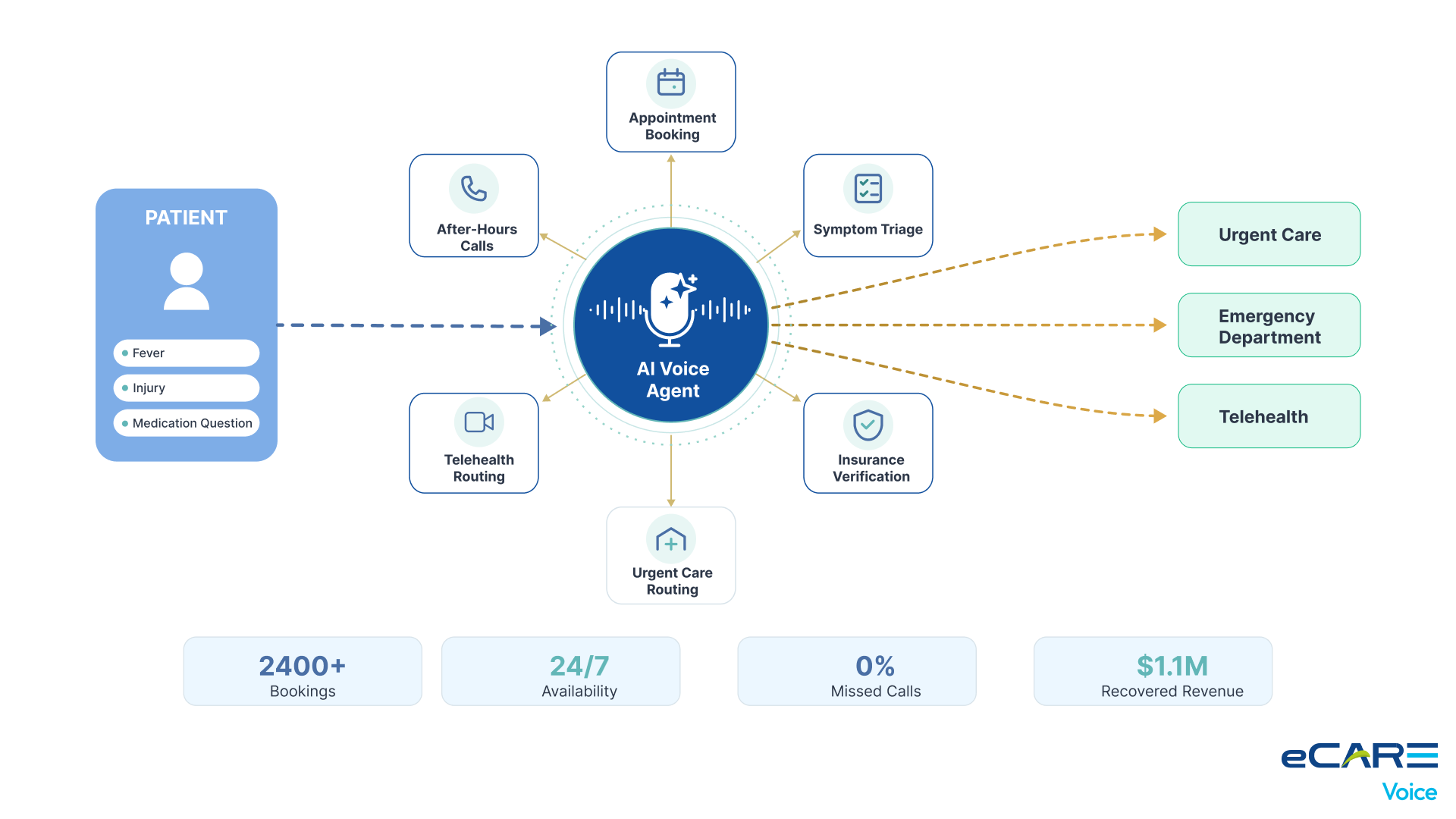
The other capability that closed the procurement was the symptom-triage workflow. eCareVoice's voice agent could perform structured symptom triage that routed patients appropriately — to urgent care for urgent-care-appropriate complaints, to the ED for serious-symptom presentations, and to telehealth for non-urgent concerns. The triage was clinically curated by Midwest's medical director during configuration. The workflow added clinical value beyond simple appointment booking.
Value Delivered
The after-hours booking workflow went live on day 26. By day 60 — the survival timeline Steve had set — the platform had captured 240% more after-hours bookings than the prior baseline. The market loss to the competitor stabilized. By month 6, the Midwest had recovered approximately 70% of the share it had lost in the first 30 days of competition.
- After-hours bookings grew 240% vs prior baseline; previously-lost overnight volume returned to the Midwest.
- $1.1M incremental annual revenue from captured after-hours booking volume.
- Peak-hour demand is smoothed through off-hour booking shifts; patients who would have been peak-hour walk-ins are now scheduled off-peak.
- Insurance verification pre-arrival automated; front-desk bottleneck during peak hours decreased measurably.
- Patient satisfaction with voice-agent interactions: 4.7 out of 5.
Solution Provided
The deployment ran 8 weeks total. The pacing was compressed by the competitive timeline. eCareVoice's team treated it as a competitive-readiness sprint.
Days 1–14: Setting Up the Agent
The first two weeks were technical configuration. eCareVoice connected to the Midwest's scheduling system, configured the appointment-booking workflow for the 9 clinic locations, and built the symptom-triage logic with the medical director. By day 14, the configuration was live in test mode.
Days 15–26: Pilot at Flagship Site (After-Hours Only)
The pilot ran at the flagship Indianapolis site for after-hours bookings only. The platform handled after-hours calls; daytime calls continued through the existing workflow. The flagship was selected because it was the site facing the competitive pressure, and the staff had the highest operational urgency about the deployment.
Days 26–35: Full Site Deployment (After-Hours)
The remaining 8 sites transitioned to the after-hours workflow over 9 days. By day 35, all 9 sites were handling after-hours calls through the voice agent. The aggregate after-hours booking volume had jumped meaningfully; Steve could see the data in the daily reporting cockpit.
Days 35–50: Daytime Workflow Expansion
The voice agent expanded to handle daytime overflow during peak hours. The site staff had welcomed the overnight handoff (they hadn't been working overnight anyway); the daytime handoff required more workflow tuning. The voice agent picked up calls when wait times exceeded 90 seconds, with full handoff context to the human staff if the call escalated.
Days 50–60: Symptom Triage Activation and Insurance Pre-Verification
The final phase activated the clinical symptom triage and insurance pre-verification workflows. Patients booking through the voice agent received a basic triage that flagged inappropriate-for-urgent-care presentations; their insurance was verified before arrival, eliminating the front-desk bottleneck during peak hours.
Business Value
Steve presented the engagement results to the executive committee at the 90-day post-deployment mark. The framing was that the Midwest had survived a competitive entry that could have permanently displaced the flagship site.
What the engagement preserved
The flagship's overnight market share has substantially recovered. The competitive entry has settled into a market-share split that is operationally manageable rather than existentially threatening. Steve's view is that the 60-day platform deployment was the difference between Midwest holding its market position and Midwest losing it.
The financial picture
The $1.1M incremental annual revenue from captured after-hours bookings is the immediate financial impact. The avoided cost of overnight phone staffing (approximately $180K annually that Steve would have incurred if the platform option hadn't existed) was factored into the operational economics. Total annual financial impact: approximately $1.3M against a $140K implementation cost. The recurring annual value is meaningful.
What changed about the Midwest's competitive posture
The 24/7 bookable capability is now positioned as a Midwest service feature rather than a competitor differentiator. Marketing materials reference it explicitly. The competitive advantage that the new entrant had built around has been neutralized. Steve has been clear that the platform produced operational parity rather than competitive advantage, but operational parity was the survival requirement.
What Steve says publicly
“A competitor opened with a feature we didn't have. We could have responded by hiring overnight phone staff that the labor market wouldn't have produced. We could have responded by accepting permanent market share loss. We chose to deploy a platform that gave us the same capability without the staffing problem. The competitive entry remained competitive. We remained operational. That was the deliverable.”